

How to Revive a Hotel Business: A Strategic Business Turnaround Guide
With over 35 years of experience in the hospitality business, the Everly Group has gained valuable knowledge that gives them a complete and clear picture of how to successfully achieve and drive growth.Turning a struggling hotel into a profitable venture requires more than just minor tweaks, it demands a comprehensive turnaround strategy that addresses financial, operational, and guest experience issues simultaneously. If your hotel business is failing to generate desired profits, you must implement a structured plan to stabilize finances and reposition your property for success.
Phase 1: Diagnosis and Financial Stabilization
Before making large investments, the first step is a deep, objective analysis followed by immediate financial triage.
1. Conduct a Comprehensive Analysis
Begin with a thorough financial assessment of performance, operational inefficiencies, and competitor benchmarking in the local market.
2. Identify the core problems
Are expenses too high, or is revenue too low? Data-driven insights must guide your recovery plan.
3. Prioritize Radical Cost Control
Review all budgets and look for immediate areas to cut costs without compromising guest quality. This includes:
- Renegotiating supplier contracts to secure better rates.
- Implementing efficient inventory management systems.
- Reducing costly, underperforming paid marketing efforts and switching focus to no-cost or low-cost social media marketing.
- Controlling energy consumption through efficiency measures.
4. Implement Dynamic Pricing
Move away from static pricing. Use a dynamic pricing strategy that adjusts room rates and cancellation policies based on real-time demand, events, and competitor rates to maximize revenue per available room (RevPAR).
Phase 2: Operational Efficiency and Staff Empowerment
A successful turnaround relies on leveraging technology for efficiency and transforming the staff into a proactive asset.
1. Streamline Operations with Technology
Invest in modern, affordable cloud-based technology like automated Property Management Systems (PMS) and digital guest management tools. This reduces manual errors, enhances department communication, and frees up staff time to focus on guests.
2. Empower and Train Your Staff
Your employees are the frontline of the guest experience. Invest in cross-resource utilization (cross-training staff) to increase efficiency and reduce the expense of hiring new employees. Critically, increase employee engagement by seeking their input on operations and providing timely recognition and rewards for performance.
3. Enhance the Guest Experience
Systematically address all guest feedback, especially negative reviews. Train staff to provide personalized service and respond quickly to needs. Remember, positive word-of-mouth and strong online reviews are vital, low-cost marketing tools that build your hotel’s reputation and attract new bookings.
Phase 3: Revenue Generation and Market Repositioning
Once stabilized, you must look for creative ways to boost revenue and reposition the hotel to attract new markets.
1. Monetize Underutilized Space
Survey the property and identify spaces not generating income. Convert these areas into short-term revenue streams by hosting small local events like yoga classes, workshops, or family gatherings. This creates side income and introduces new customers to the hotel.
2. Leverage Local Partnerships
Build strategic relationships with local businesses, tourist attractions, and event organizers. Create exclusive, value-added packages that promote both your property and your partners, enhancing the overall guest experience and appeal.
3. Strategic Repositioning and Branding
If needed, consider a rebranding effort to appeal to a more profitable market segment (e.g., business travelers, niche wellness guests, or families). Utilize modern digital marketing channels and ensure your website is search engine optimized (SEO) to highlight your unique offerings and new market focus.
4. Adapt to Industry Trends
Stay ahead of the competition by monitoring and adapting to changing industry trends and guest expectations. Being the first to offer a desired new service or amenity can create significant market advantage.
Our Real-World Insights
This section dives into specific, real-world case studies and operational insights detailing the hard-won wisdom of our seasoned hoteliers. You’ll find practical strategies for profitable hotel design, rigorous F&B cost control, and leveraging the MICE sector to transform our property into a market leader.
1. Strategic Hotel Design and Market Alignment

The Blueprint for Profitable Hotel Design
Designing a hotel that meets market needs and ensures profitability requires strategic planning, especially in areas with limited demand. Let’s explore how to design profitable hotels, starting with smaller establishments in small towns or suburban areas.
A. Small Towns or Suburban Areas with Limited Demand
In areas with minimal business or industrial activity within a 10-kilometer radius, demand for hotel rooms is typically modest. Here’s how to design a commercially viable property:
Key Characteristics of the Area:
- Primarily residential with limited commercial or industrial activity.
- Room night demand averages 30-50 rooms per day.
- No significant need for meeting rooms or large dining facilities.
Hotel Design Recommendations:
1. Room Count:
- Limit to 40-60 rooms, depending on the local demand.
2. Operational Efficiency:
- Utilize self-check-in counters to reduce staffing needs at the front desk.
- Focus operational staff primarily on housekeeping and maintenance.
3. Food & Beverage Services:
- Offer a self-service breakfast option to minimize labor costs while meeting guest expectations.
- Eliminate the need for a full café or large-scale dining facilities.
Expected Guest F&B Business by Room Count:
| Metric | 40 Rooms | 60 Rooms |
| Average # of Guests (1.4 per room) | 56 guests | 84 guests |
| Basis Occupancy (%) | 100% | 100% |
| Breakfast (%) | 80% (45 guests) | 80% (67 guests) |
| Lunch (%) | 5% (3 guests) | 5% (4 guests) |
| Dinner (%) | 12% (7 guests) | 12% (10 guests) |
| Overnight F&B (%) | 0.1% (0.1 guests) | 0.1% (0.1 guests) |
Strategic Insights:
1. Self-Service Breakfast:
- A simple breakfast setup, such as cereals, pastries, coffee, and juice, allows guests to serve themselves, reducing the need for F&B staff.
- This approach enhances cost efficiency while providing a valued amenity.
2. F&B Adjustments:
- Focus only on breakfast; skip lunch and dinner services unless market demands justify otherwise.
3. Operational Focus:
- Leverage self-check-in technology to minimize front desk staffing.
- A lean team focused on housekeeping and minor maintenance ensures efficiency.
4. Target Market Alignment:
- These smaller hotels cater well to travelers passing through, visiting family, or attending small local events.
For small towns and suburban areas, designing a lean and efficient hotel with limited services ensures profitability by aligning with the modest demand. Offering a self-service breakfast enhances guest satisfaction while keeping operational costs low, making the business model sustainable.
B. Mid-Size Cities and Outlying Neighborhoods of Larger Cities
In mid-size cities or outlying neighborhoods of larger urban centers, hotels must strike a balance between operational efficiency and guest satisfaction. These areas often combine moderate business demand with some leisure activity, requiring a strategic approach to design and operations.
Key Characteristics of the Area:
- Location: Proximity to commercial or industrial zones enhances demand.
- Accessibility: Ideally within 100 meters of shopping centers or mass transit hubs.
- Market Mix: Primarily business travelers with some leisure guests, especially if near a larger city.
- Facilities Need: Minimal demand for large meeting rooms or banquet halls.
Hotel Design Recommendations:
1. Room Count:
- Limit to 80-120 rooms, aligned with local demand.
- A 3 star hotel will suffice.
2. Operational Efficiency:
- Utilize self-check-in counters to streamline front desk operations.
- Focus operational staff on housekeeping and maintenance for cost control.
- Include a 12-seater meeting room primarily for hotel use, with rental options.
- At this size the management overhead starts to increase.
3. Food & Beverage Services:
- Avoid adding a banquet hall or multiple meeting rooms as the sales staff costs often outweigh potential revenue.
- For breakfast:
- Provide a single chef setup, especially in regions where simple options like an egg station and/or simple hot food suffice.
- Alternatively, rent out the restaurant space and negotiate breakfast arrangements separately.
Expected Guest F&B Business by Room Count:
| Metric | 80 Rooms | 120 Rooms |
| Average # of Guests (1.4 per room) | 112 guests | 168 guests |
| Basis Occupancy (%) | 100% | 100% |
| Breakfast (80%) | (90 guests) | (134 guests) |
| Lunch (5%) | (6 guests) | (8 guests) |
| Dinner (12%) | (13 guests) | (20 guests) |
| Overnight F&B (0.1%) | (0.1 guests) | (0.2 guests) |
Strategic Insights:
1. Breakfast Feasibility:
- With a steady breakfast crowd, offering minimalistic breakfast options ensures operational efficiency.
- Renting out the restaurant can further reduce overhead costs.
2. Lunch and Dinner Strategy:
- Limited guest demand makes offering full lunch and dinner service uneconomical.
3. Operational Focus:
- Use technology for self-check-in and streamline housekeeping and maintenance efforts.
4. Market Alignment:
- Focus on business travelers and leisure guests.
- Leverage MICE opportunities operated by third parties in the area for supplementary demand.
For mid-size cities or suburban locations, designing a hotel with 80-120 rooms and minimal F&B facilities ensures profitability. Operational efficiency, targeted amenities, and strategic partnerships with nearby MICE venues can further enhance success in this demographic.
C. Large and Capital Cities – Next Larger Size Hotels
Large cities, including capital cities, present a dynamic mix of business and leisure travel opportunities. Hotels in these locations benefit from serving three primary demand anchors: business travelers, leisure guests, and MICE (Meetings, Incentives, Conferences, and Exhibitions) business. A well-designed hotel catering to all these markets can achieve sustainable profitability.
Key Characteristics of the Area
- Location: Proximity to commercial/government hubs, leisure destinations, and MICE venues.
- Accessibility: Close to shopping centers and mass transit hubs, ideally within 100 meters.
- Market Mix: A balanced mix of business travelers, leisure guests, and MICE participants.
- Facilities: Adequate ballrooms and meeting rooms proportional to the hotel size.
Hotel Design Recommendations
1. Room Count:
- Optimal size: 300-500 rooms, based on demand.
- A 4-star rating is sufficient to meet most market expectations.
2. Operational Efficiency:
- Blend manned front office services with self-check-in technology for seamless guest experiences.
- Management overhead will marginally increase from smaller hotels but remains manageable.
- Business demand peaks from Sunday to Thursday, while leisure peaks over weekends.
3. Food & Beverage Services:
- Ballroom: Minimum seating for 1,000 guests, with 12-20 meeting rooms for efficient sales and operations.
- Buffet restaurant: Serve breakfast, lunch, and dinner, primarily tied to conference packages.
- Café: A 40–60 seat café with a 2-piece band for evening ambiance.
4. Fitness and Recreation:
- A well-equipped gym for in-house guests.
- Swimming pool for leisure and relaxation.
Expected Guest F&B Business by Room Count
| Metric | 80 Rooms | 120 Rooms |
| Average # of Guests (1.4 per room) | 420 | 700 |
| Basis Occupancy (%) | 336 | 560 |
| Breakfast (80%) | 21 | 35 |
| Lunch (5%) | 50 | (8 guests) |
| Dinner (12%) | (13 guests) | 84 |
| Overnight F&B (0.1%) | 0.4 | 0.7 |
Strategic Insights
1. Breakfast Feasibility:
- Serve a comprehensive buffet catering to both in-house guests and conference attendees.
2. Lunch and Dinner Strategy:
- Link buffet services to conference packages, avoiding general lunch and dinner unless tied to events.
- Use live cooking stations to reduce waste and enhance the dining experience.
3. Operational Focus:
- Leverage autonomous luggage robots and technology to enhance guest convenience and reduce labor costs.
- Centralized food preparation minimizes the need for highly specialized kitchen staff.
4. Facilities for MICE:
- A 1,000-seater ballroom with 12-20 meeting rooms ensures a strong revenue stream from conferences.
5. Strategic Flexibility:
- Adapt banquet and meeting room offerings based on event sizes to maximize profitability.
Key Takeaway
Hotels in large and capital cities thrive by catering to the diverse needs of business, leisure, and MICE travelers. Strategic design that integrates technology, operational efficiency, and targeted F&B services ensures long-term profitability and competitiveness in these high-demand markets.
MICE Revenue Meetings and Incentives
The third foundation of the rooms business in a hotel is the Meetings, Incentives, Conferences, and Exhibitions (MICE) sector. Often referred to as the “meetings industry” or “events industry,” MICE represent a vital revenue stream that combines business-focused gatherings with innovative leisure elements to engage attendees.
What is MICE?
MICE is an acronym for meetings, incentives, conferences, and exhibitions. These events are core to global business travel, bringing professionals together to foster connections, share ideas, and drive growth. While traditionally focused on business, modern MICE events often include leisure activities to enhance attendee experience.
1. Meetings
Meetings are typically single-day events held in hotel conference rooms or convention centers. These events are smaller in scale, ranging from senior executive gatherings to annual shareholder meetings.
- Purpose: Align goals, address challenges, and plan initiatives.
- Structure: Simple catering and minimal entertainment.
2. Incentives
This is the most enjoyable component of MICE! Incentives are travel rewards offered by companies to employees, teams, or partners to celebrate achievements or boost morale. These range from luxurious weekend retreats to team-building activities closer to home.
- Goal: Strengthen loyalty and inspire higher performance.
- Format: Flexible, from full trips to single-day events.
Takeaways from Meetings and Incentives
Both components emphasize the importance of location, convenience, and atmosphere. While meetings demand functional and professional settings, incentives lean on creativity and memorable experiences. Hotels that cater well to both can secure long-term relationships with corporate clients.
Continuing our exploration of the MICE business, we now turn to Conferences and Exhibitions, which often bring global attention and significant revenue to host hotels.
3. Conferences
Conferences are like supersized meetings, spanning multiple days with hundreds or even thousands of attendees. They blend professional growth opportunities with networking and collaboration.
Common Activities:
- Keynotes: Industry leaders share ideas and address critical issues.
- Panels: Experts discuss trends, innovations, or challenges.
- Workshops: Interactive sessions for skill-building or problem-solving.
Purpose: To present new insights, solve industry problems, and strengthen professional relationships.
4. Exhibitions
Also known as trade shows, exhibitions are massive events that attract visitors and exhibitors worldwide. These events allow companies to showcase their products, network, and identify potential partners.
Key Features:
- Networking Events: Subgroup parties for collaborations and trend discussions.
- Awards Ceremonies: Celebrating industry leaders and fostering innovation.
- Business Pitches: Platforms for startups to gain visibility and clients.
- Strategic Importance: Exhibitions are a boon for hotel branding, positioning them as central hubs for industry innovation.
The Balanced Strategy for MICE Success
Hotels targeting the MICE market must balance professional appeal with memorable experiences. From tailored packages for business travelers to leisure-focused incentives, a well-rounded strategy ensures long-term profitability and strong client relationships.
The Essential Hotel Design Brief
Good hotel design is not just about aesthetics, it directly impacts efficiency, guest satisfaction, and return on investment. The design brief must strategically address both guest-facing areas and the critical back-of-house operations to ensure long-term profitability. A badly designed room, such as one that makes the room feel cramped or restrain movements, which directly hurts sales by leading to negative online reviews and discouraging repeat bookings.
Key Design Components
- Define the type of hotel based on location and commercial design considerations (as previously posted).
- Determine the number of rooms with a self/low-service breakfast area.
- For larger hotels with 200 rooms and above, incorporate:
- Banqueting and meeting rooms.
- A buffet coffee shop serving breakfast, lunch, and dinner to support banqueting needs.
- A small café for potential entertainment, sales discussions, and additional dining options.
- Swimming pool.
- Gym.
- Back-of-house areas, including offices, maintenance, housekeeping, staff changing rooms, and a canteen. Due to our operational efficiency, we typically require only 40% of the space needed by international operators (as covered in previous posts).
- Housekeeping with an in-house laundry for emergencies and internal needs. However, outsourcing laundry is generally more cost-effective unless operating a group of hotels within a few hours’ travel, in which case a central laundry facility may be considered.
Key Design Considerations
- Room Orientation: Rooms should face North and South to minimize heat exposure. Rooms facing East or West increase air-conditioning costs due to higher sun exposure.
- Room Size & Bed Configuration:
- 30% Single King or Queen beds.
- 70% Super Double beds.
- Interconnecting Rooms: At least 30% of rooms should be interconnecting, with some options connecting to suites.
- Corridor Layout:
- Rooms should be arranged in straight rows with double-stacked corridors.
- Avoid curved or staggered corridors, as they increase maintenance issues due to the difficulty of maneuvering trolleys.
- Banquet & Meeting Room Placement: In larger hotels with sufficient land, these should be positioned adjacent to the room buildings. This prevents guests and banquet attendees from sharing lifts, allowing for dedicated lifts sized specifically for banqueting and meetings.
- Elevator Requirements:
- 1 elevator per 100 rooms above the ground floor.
- In some cases, this can be stretched to 1 per 120 rooms without significantly affecting response times.
- Transfer Floor Utilization: If construction requires a transfer floor, design it to recover dead spaces for staff accommodations.
- Housekeeping Logistics:
- Each floor should have 25 to 30 rooms, manageable by a single cleaner.
- A housekeeping storage room with a laundry chute should be included, connecting directly to the basement’s back-of-house area.
By implementing these design strategies, we ensure operational efficiency, cost savings, and an optimal guest experience.
Final Thought:
“Good hotel design is not just about aesthetics—it directly impacts efficiency, guest satisfaction, and return on investment. Thoughtful planning from the outset can prevent costly mistakes and operational inefficiencies in the long run.”
2. Rigorous Utility and Operational Cost Control
A. Understanding Fixed and Variable Utility Costs
Before moving on to the brief for the Mechanical and Electrical (M&E) engineer, I wanted to share some insights I’ve gained about the fixed and variable costs of utilities—and how they relate to the revenue from each business unit.
When I started in the hotel business, I had assumed that all utility costs were variable and would rise or fall based on daily business levels. How wrong I was! We began tracking the daily utility consumption across all our hotels. Wherever possible, we installed separate meters for each business unit. We then correlated daily business data with utility consumption, generating charts for senior managers. This allowed them to immediately investigate any anomalies—whether it was unexpectedly high usage or unusually low consumption that could be replicated.
Electricity Consumption: A Closer Look at Room Operations
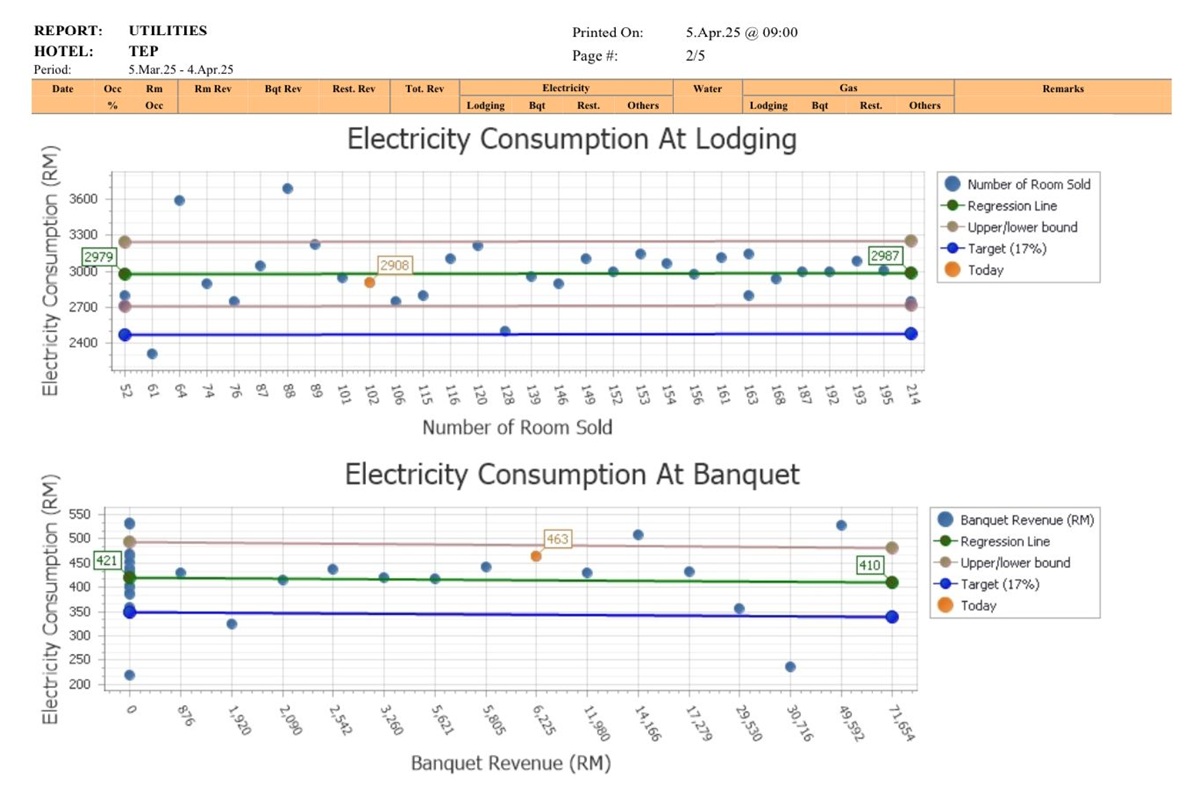
The first chart we analyzed focused on electricity consumption for guest rooms. Here’s what we observed:
- The vertical axis represents electricity cost in RM.
- The horizontal axis indicates the number of rooms sold per night.
- The green regression line is relatively flat, illustrating that room electricity consumption doesn’t vary dramatically with occupancy.
- When extrapolated to zero rooms sold, the fixed cost was approximately RM 2,700.
- The slope of the regression line—which represents variable cost—is low, probably no more than RM 1 per additional room sold.
- We added upper and lower limit lines based on two standard errors (a close proxy for two standard deviations). This means 95% of our daily values fall between these boundaries.
- The orange dot represents the previous night’s reading—RM 2,908.
- If the dot lies outside the upper or lower limits, managers are alerted to investigate further. If it’s unusually low, what worked well? If it’s unusually high, what went wrong?
We generated similar charts for other business units and utilities. Once you understand the first chart, the others become self-explanatory.
These insights helped us move from reactive to proactive management of utility costs ensuring tighter cost control and increased operational efficiency.
Final Thoughts
Utility costs can’t be managed effectively without first understanding their true behavior. Don’t assume they’re fully variable—track, chart, and learn from the patterns. The data will guide your decisions far better than assumptions.
B. Back of House Efficiency Lesson
The first morning after I moved into the hotel, I took a tour of the back of the house. I saw an air-conditioned store with a full-time storekeeper and noticed that all the stock consisted of printed forms and stationery. I wondered why we were in the stationery business!
During the morning briefing, I asked the accountant about the value of the inventory in that store and was told it was about RM 40,000. My thoughts were that the full-time storekeeper plus the cost of 24-hour air conditioning would cost us RM 30,000 per year. What an awful waste of money!
Over the next two days, I asked the stationery supplier to take back all the stationery we had bought from them to store. I told the supplier we would fix all the stationery prices for the next two years. The new procedure would be that each department would prepare a list of stationery they needed on a Wednesday, and the lists would be sent to the stationery supplier on the same day. The stationery would be delivered to the requesting department on Friday with an accompanying bill addressed to that particular department.
The accounting department would capture the cost directly to the concerned department. This simplified all the accounting work needed to keep track of stationery costs. Next, all the forms for each department were sorted out by departments and sent to them for safekeeping. They would keep their inventory and take their own stock at the end of each month. The forms were not items anyone would be interested in stealing. The store was closed down for other usage, and the storekeeper was reassigned.
Fast Forward
We now only allow printing of forms for 3 to 6 months as forms keep improving. We have also moved from forms to spreadsheets and then to our own software programs that handle such matters efficiently.
Strategic Lesson: Simplified procedures with less work.
The total yearly cost savings was at least RM 50,000, and the workload was reduced for everyone. Although it was not a huge amount of money, a dollar saved is a dollar of profit.
3. Restructuring Food & Beverage for Profitability
A. Why a 160-Seat Chinese Restaurant Will Always Lose Money
After I moved the coffee shop to the mezzanine floor, we had to brainstorm what to do with the old coffee shop space. After much thought, we decided it should be a Chinese restaurant.
We planned to offer Dim Sum, Cantonese cuisine, and a barbecue section. After three months of renovation, the “Fortune Palace” was born.
I had instructed my accountant to prepare the monthly financials based on a complete profit center basis, including utilities and rent. After about six months of reaching RM 160,000 per month (RM 1,000/seat of 160 seats) and running losses every month, I asked the hotel consultant what was going on. The reply was, “It’s like that.”
I told myself I was an idiot for listening to others and not educating myself in the Chinese restaurant business first.
I sought inputs from two very successful restaurants and the manager and chef of the most successful Chinese restaurant in a hotel at that time. I found out that the Fortune Palace was a misfortune and would never make money.
We needed a minimum of 500 seats to cater to weddings for a Chinese restaurant to be profitable (today it is 1,000 seats). The chef crew of three cost RM 25,000 per month, which a 160-seat restaurant could not absorb. The Dim Sum and Cantonese food could not share cooking staff as the cooking processes were completely different. In other words, we had two restaurants rather than one!
Strategic Lesson: Proper market research and understanding of the business model are crucial before making significant investments. Relying solely on external advice without personal knowledge can lead to costly mistakes.
B. Location Drives Restaurant Success
In a hotel, the breakfast area can be located almost anywhere. However, if the same venue is open for lunch and dinner, it must be positioned in the highest traffic area of the hotel, where guests can see the activity and be drawn in.
For a Chinese restaurant, where weddings are a key source of income, it’s essential that the entrance exudes grandeur, and the wedding experience is unforgettable. Therefore, a large Chinese restaurant should be prominently and visibly located, offering a grand sense of arrival.
When it comes to Western cuisine like Italian or French, visibility is crucial. These restaurants need to be in a presentable neighborhood with street traffic, or in the case of a shopping center, where walk-by traffic is high. Western restaurants are often trendier, and generating buzz is key to attracting customers. From my observations of well-known restaurants in Western cities, I’ve noted that seating around 50 guests is optimal. A single chef-owner can manage this number, ensuring both quality and precise timing for a delightful dining experience.
While researching different types of restaurants, I became intrigued by the success of Japanese restaurants, which often thrive in tucked-away locations. I realized that in major Japanese cities, where rent is high, these restaurants often occupy hidden corners or below-street-level spaces where rent is cheaper. Additionally, Japanese cuisine, especially sushi and sashimi, isn’t driven by trends. Consistency is what builds a loyal clientele, and they’ll remember the location no matter how inconspicuous it may be.
Strategic Lesson Learned: If the neighborhood surrounding the hotel cannot generate the traffic needed to sustain the restaurant, that restaurant will inevitably lose money.
Strategic Question: Can the restaurant being planned for the hotel thrive on its own, independent of the hotel? If the answer is “yes,” then proceed.
C. Centralized Kitchen Strategy to Control Food Costs in Hotel Operations
During the six months prior to my takeover as Managing Director, I was intrigued by the mezzanine floor overlooking the entrance and the lobby of the hotel. There was a piano bar with a singer and a piano player performing six days a week. However, there were hardly any customers, and having 4-5 patrons was considered a good night.
For three weeks, I sat on a raised area of the mezzanine, trying to imagine its potential. I concluded that it would be the perfect location for a coffee shop. Since it overlooked the entrance and the lobby counter, everyone could observe who was coming and going, and who was checking in with whom—amazing fodder for the imaginative mind. However, this suggestion was turned down by everyone as we couldn’t have the kitchen attached to the venue.
After I was appointed, the day came when the existing coffee shop was to be renovated. Guess where the temporary coffee shop was to be located? The mezzanine. That early morning, while taking my son to the park for a run, I saw the setup and fell in love with it. On my return, I interviewed every customer who ate there throughout the day, and there was overwhelming enthusiasm for the coffee shop to remain there.
I decided to move the coffee shop to the mezzanine despite the challenge of having to transport the food across the lift lobby. We had to cancel the interior design contract at a loss of RM 150,000. This move increased the monthly revenue from RM 80,000 to more than RM 280,000 within three months.
Strategic Lesson: Coffee shops attract more customers when they can view what’s going on.
I was euphoric with this success, only to later learn that life in business is not always that simple.
The Accidental Hotelier – To Centralize or Not to Centralize the Kitchen?
Balancing food quality and operational efficiency is always a challenge. Many hotel restaurants manage their own raw food supplies directly from vendors, requiring more senior chefs and a highly disciplined team. However, with the high staff turnover in the hospitality industry, maintaining consistent food quality across multiple outlets becomes increasingly difficult.
When designing hotels with multiple food and beverage outlets, we have always incorporated a centralized Raw & Cooked Food Production (RCFP) unit.
The Everly Putrajaya: Centralized Kitchen Layout
Floor B2 – Loading Bay & Kitchen Areas (m²):
| Area | Function | Size (m²) |
| a) | Refuse Compost Area | 66.7 |
| b) | Loading Bay Area | 69.8 |
| c) | Raw & Cooked Food Production (RCFP) | 179.8 |
| d) | Pastry | 63.8 |
| e) | Hot Kitchen | 64.8 |
| f) | RCFP Chiller (Fruits) | 13.2 |
| g) | Freezer for Pastry | 13.2 |
| h) | RCFP Chiller (MEP) | 13.2 |
| i) | Dishwasher Area & Store | 25.5 |
| j) | Walkway | 110.4 |
| Total | 620.4 |
The RCFP unit handles all food from the moment it is received, processed into final or semi-final cooked products, and stored in chillers and freezers. The prepared food is then dispatched to the banquet kitchen, Fuze kitchen, Neuvo kitchen, and Executive Lounge. Each of these kitchens maintains its own chiller and freezer space, allowing for one day’s inventory to ensure hot and fresh food service.
This strategy enables zero leftover inventory at the end of the day or after a banquet event, allowing for instant food cost tracking and improved cost control.
Centralized Kitchens in Standalone Restaurants
Recently, I had the opportunity to advise friends who own multiple restaurants under one brand and were considering investing in a central kitchen. The challenge for standalone restaurants is achieving a critical mass—a certain number of outlets with consistent sales volume—otherwise, profitability becomes difficult.
On the other hand, I evaluated a fast-food chain with enough outlets to justify a central kitchen, yet they chose not to implement one. The result? Severe food quality issues that are now damaging the brand.
Final Thoughts
Whether centralization is the right approach depends on the business model, scale, and operational strategy. For hotels, it enhances efficiency and cost control. For restaurant chains, it requires careful planning to ensure scalability and profitability.
Conclusion
These proven ideas and real-life examples, all based on the Everly Group’s unmatched 35 years of experience, give you the clear plan you need to turn around a hotel by focusing on what makes money and makes guests happy. Success depends on setting a culture of trust and rapid decision-making in staff, transitioning to a full profit-center structure for absolute financial accountability and making calculated, research-backed decisions on F&B design and market positioning. By applying these exact, experience-proven principles, from the 10-second complaint resolution rule to data-driven, cost-optimized hotel design that caters effectively to the MICE sector, hoteliers gain the essential tools on how to manage your hotel for long-term operational excellence and market leadership.